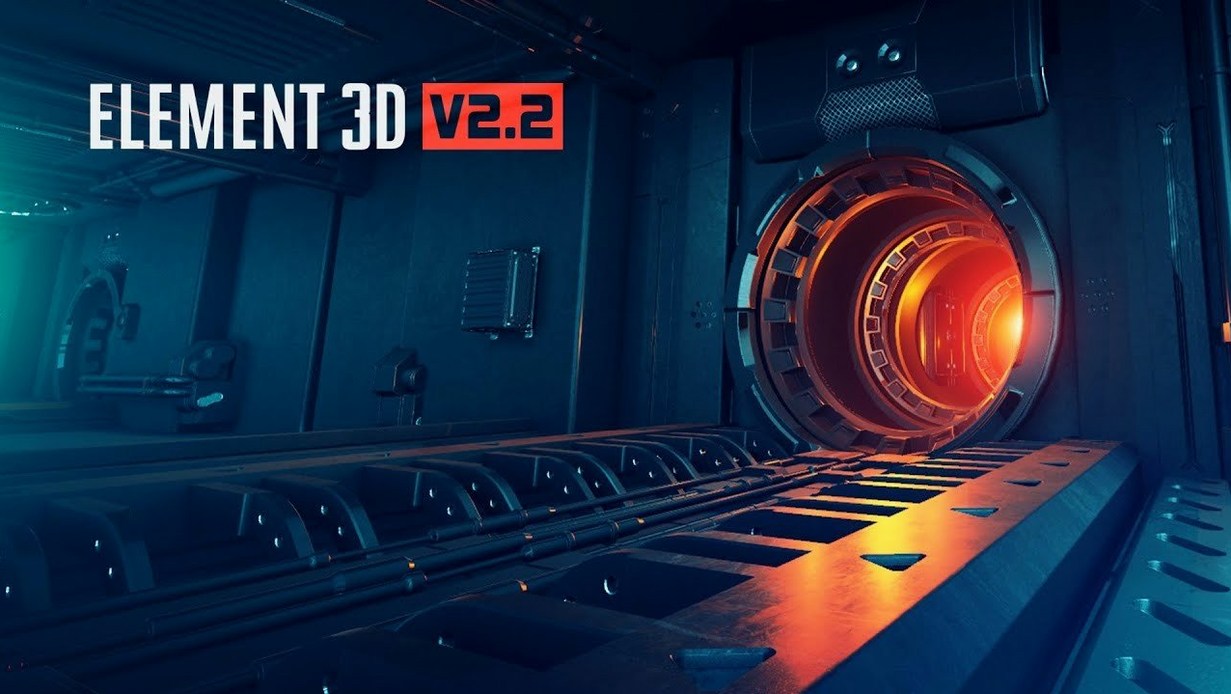
Element 3D runs on Intel-based Macs inside Adobe After Effects, providing a direct way to work with 3D objects and particle effects without leaving your timeline. It uses an OpenGL rendering engine built for speed, so you see changes as you make them. The plug-in treats 3D models as particles, giving you precise control over how objects scatter, repeat, and behave across a scene.
- Clone and distribute 3D objects across a surface or volume with the particle array system
- Manipulate object position, scale, and rotation per particle for detailed motion design
- Render reflections, shadows, and ambient occlusion in real time during preview
- Group multiple objects and apply shared animation controllers to the set
- Adjust particle look with built-in deformers for twist, bend, and noise
The engine handles heavy geometry without forcing you to bounce between applications. When a shot calls for repeated objects—flying debris, city blocks, mechanical arrays—you build it once and let the particle system do the distribution. Animation controls stay inside After Effects, so keyframes and expressions work as expected.
Double-Click the Material Sphere to Jump Straight to Textures
Several shortcuts are buried in the interface and rarely get attention in tutorials. They save a noticeable amount of repeat work once you know them.
- Double-click a material sphere to open the texture slot directly instead of navigating through the material panel.
- Hold Shift while scrubbing any spinner for finer increments — useful when a value of 0.3 looks right but 0.4 overshoots.
- Right-click a group in the scene list to duplicate it with all its replicator settings and assigned models intact.
- Press U on a selected layer in After Effects to reveal only the Element 3D keyframed properties, keeping the timeline readable.
- Drag a texture from Finder directly onto a material slot — the plug-in accepts common image formats without an import dialogue.
The particle array panel remembers your last distribution pattern per group. When you switch from a surface to a volume, the count and seed carry over, so you can iterate on an idea without rebuilding from scratch.
OBJ UVs Arrive Intact from Cinema 4D
Element 3D works best as part of a chain rather than a standalone tool. Models often start in Cinema 4D, get exported as OBJ files, and land inside After Effects through the plug-in's import dialogue. The import handles UV data and normals reliably, so textured models keep their look.
On the After Effects side, the plug-in respects standard layer controls. You can:
- Drive Element 3D properties with expressions linked to other layers
- Use adjustment layers above the Element layer for colour and blur work
- Send the final composite to Media Encoder without flattening the 3D layer first
- Use macOS Spaces to keep the scene panel and After Effects timeline on separate screens
The plug-in also picks up on After Effects proxy settings. Drop a lower-resolution stand-in for a heavy OBJ file, work out the motion, then swap in the full model when you are ready to render. This keeps previews responsive on older Intel Macs.
Bump and Specular Detail Stay Hidden Until You Raise Render Quality
Three preferences make an immediate difference after installation.
Render quality. The default draft setting keeps the preview fast but hides some material detail. Switch it to medium or high once your scene is blocked out, so specular highlights and bump maps read properly before you commit to a final render.
Shadow map resolution. Default shadows can look blocky on large objects. Raising the shadow map size smooths the edges without a huge performance hit on simple scenes. Lower it back down when you are working with dense particle fields.
OpenGL texture memory. If textures look blurry or fail to load, increasing the allocated memory lets the plug-in hold more texture data on the GPU. Start with a modest bump and test — too high a value can cause instability on older Intel machines with limited graphics memory.
Also worth a look: the auto-orient option in the particle array settings. Disabling it keeps cloned objects facing the same direction while the group moves, which is the behaviour most people expect when animating a fleet of vehicles or a field of antenna dishes.
- New — 3D object-based particle plug-in update for V2.2
- Improved — Fast OpenGL 3D rendering engine
- macOS (Intel architecture)
- Adobe After Effects
- English interface
Questions I get before install
What is Element 3D?
It is an object-based particle plug-in for Adobe After Effects, created by Video Copilot, that lets you import and animate 3D models directly on the timeline.
Which version of After Effects does it work with?
Version 2.2.3 works as an update for Element 3D V2.2 inside Adobe After Effects on Intel-based Macs.
Does Element 3D handle only particles?
No. It also renders full 3D objects with shadows, reflections, and ambient occlusion using its fast OpenGL engine.
Comments 0
Sign in to leave a comment.Sign inCreate an account
No comments yet. If a step is still there after you install it, say so.
More in Mac Apps
All in Mac Apps Elmedia Player Pro
Plays legacy and obscure media formats that other players leave unopened.
21 steps saved
 Easy New File
Creates new files from templates right inside Finder, skipping the round trip to an app.
17 steps saved
 Eagle
Finds similar images in large reference libraries so you stay focused on design, not file wrangling.
11 steps saved
 DynamicLake Pro
Surfaces your next meeting and local weather in a glanceable menu-bar strip.
22 steps saved
 Updated
Exposure X7
Combines RAW processing, local adjustments, and file management in a single editing workflow.
4 steps saved
 Dynamic Wallpaper Engine
Replaces a static desktop with live wallpapers you switch via hotkey.
6 steps saved
 DxO PhotoLab
Corrects lens flaws and noise with lab-measured profiles built into the raw editor.
11 steps saved
 Updated
Duplicate File Finder Pro
Finds exact file copies by content, not name, across your Mac and external drives.