
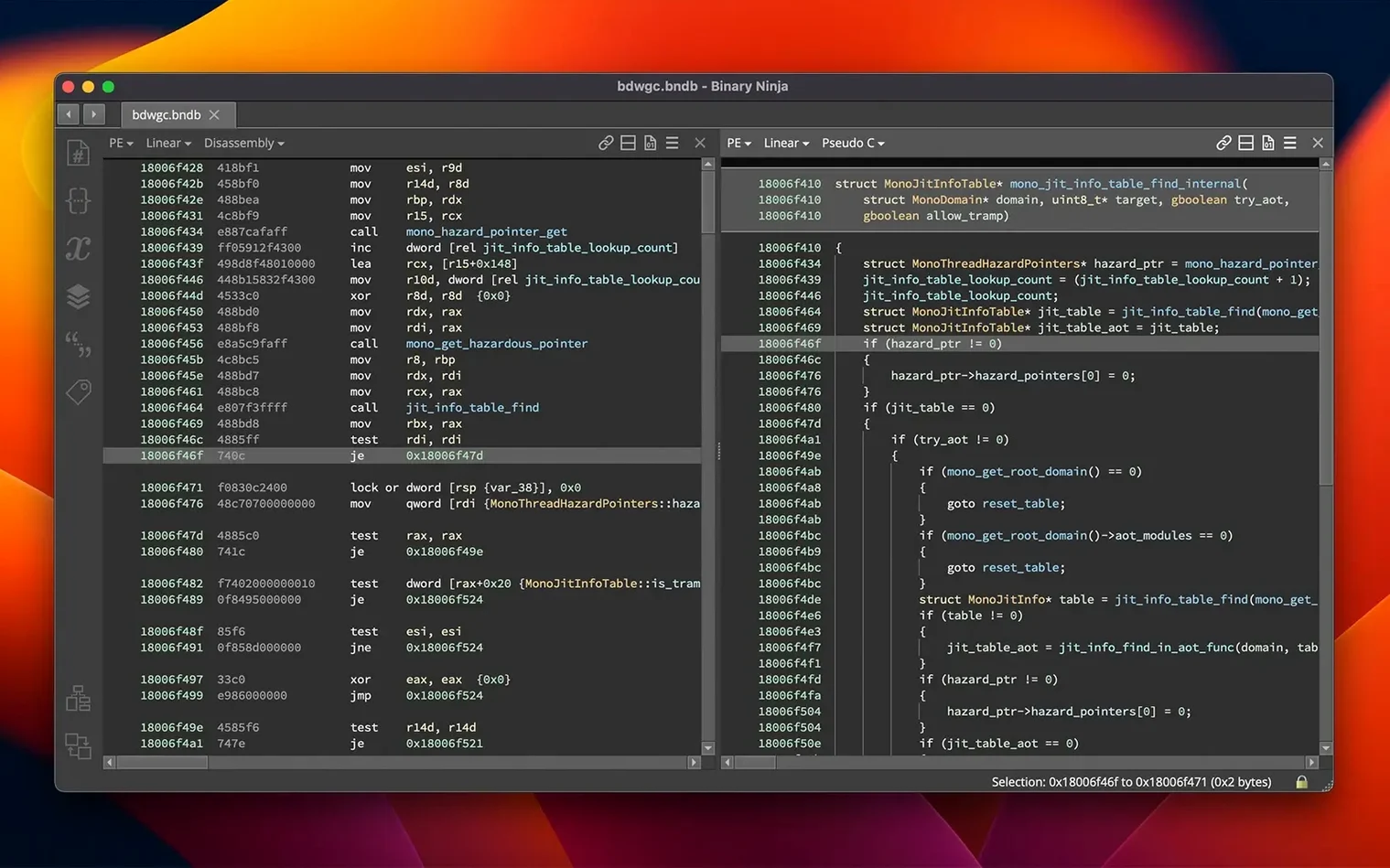
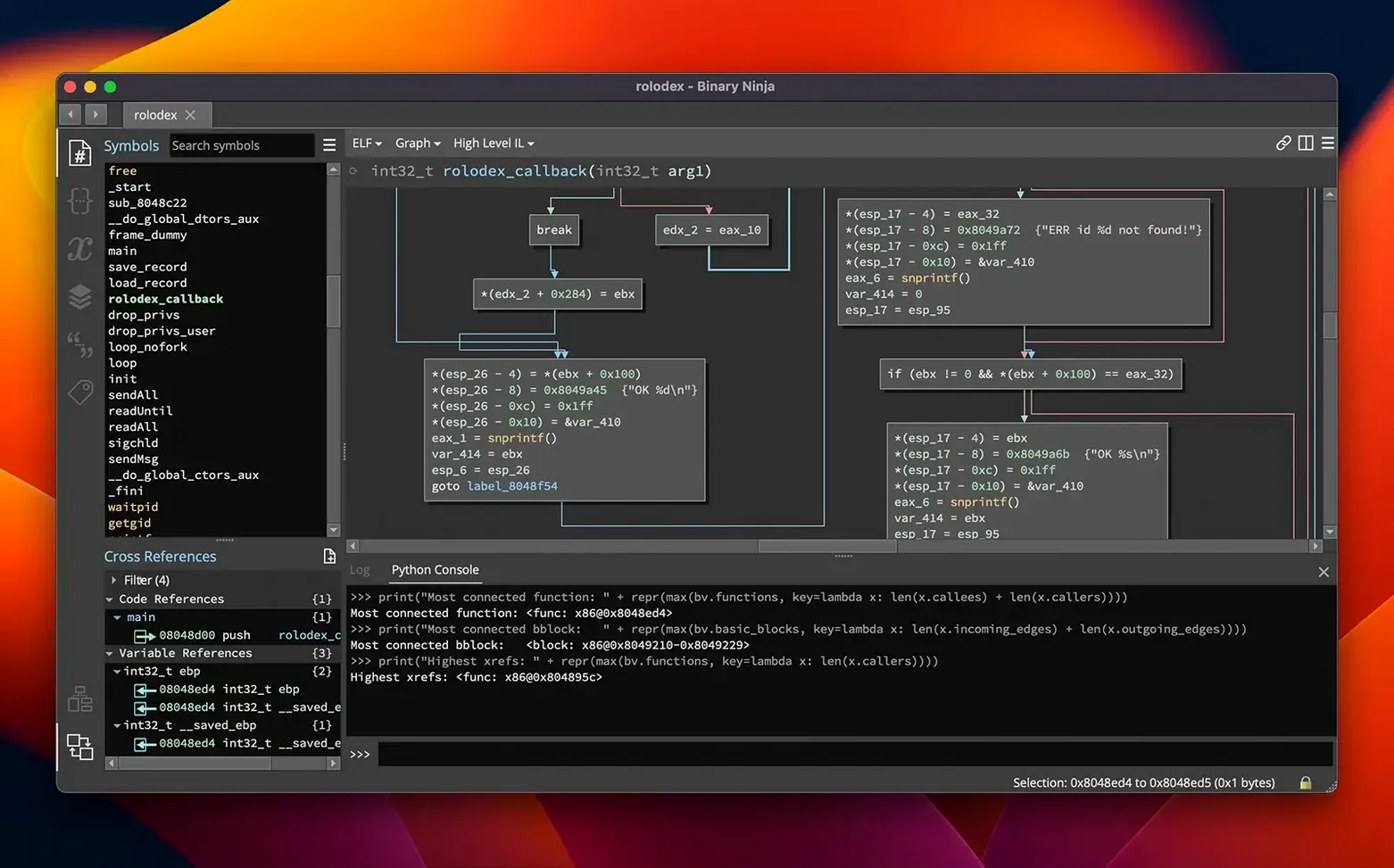
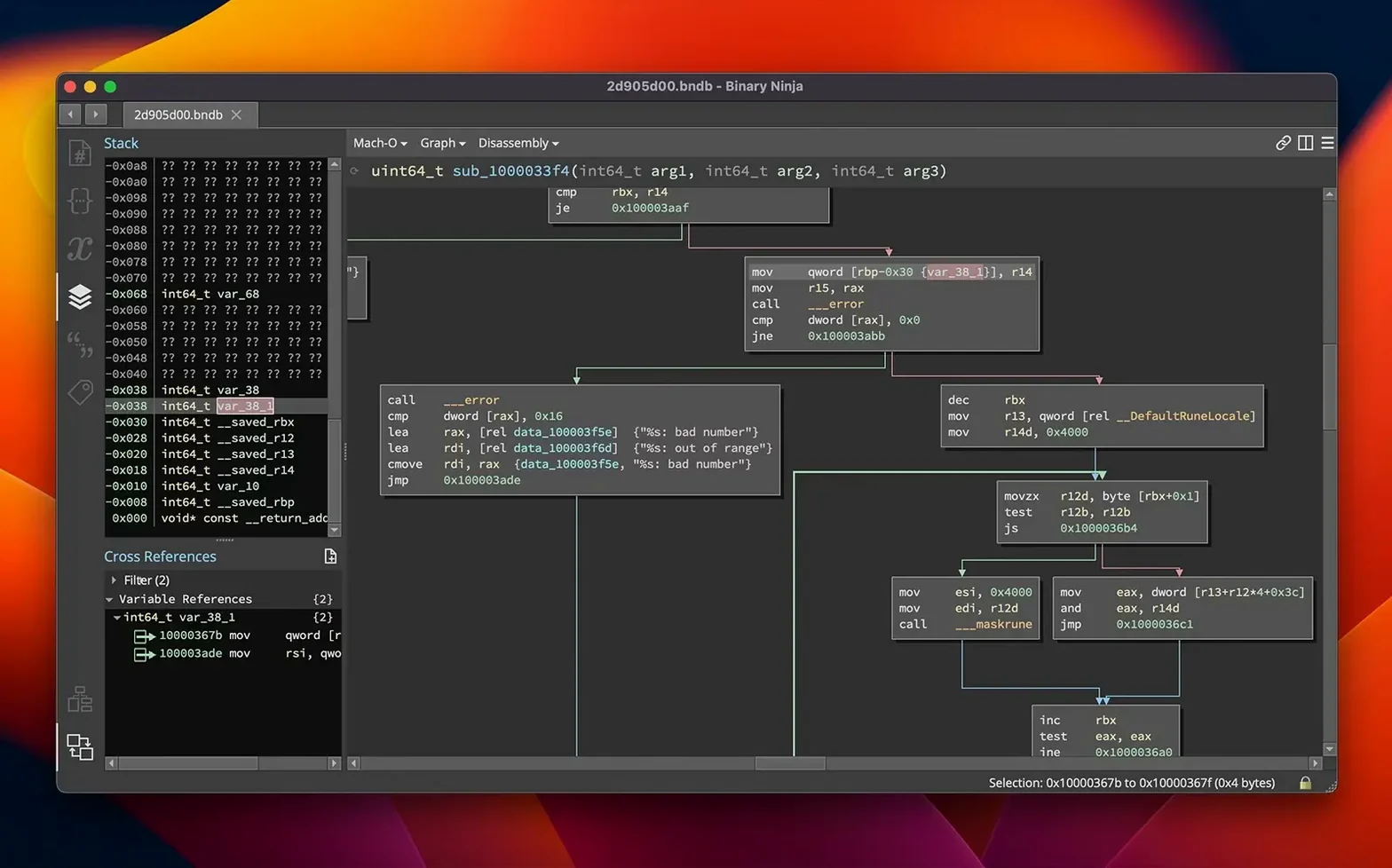
Binary Ninja is a reverse-engineering platform built for analysing binaries across a wide range of architectures. It gives you a fast disassembler, a decompiler, and an interactive environment for picking apart PE, Mach-O, and ELF files on macOS, Windows, or Linux.
On a Mac, it sits comfortably alongside your hex editor and command-line tools. You can start a headless analysis session from a terminal script, then open the same database in the GUI to name functions, apply types, and add comments without losing context. The control-flow graphs and cross-reference navigation feel immediate — useful when you are tracing how a call winds through a PowerPC or ARMv8 binary.
For teams managing custom workflows, the C++, Python, and Rust APIs let you plug Binary Ninja into your existing toolchain. Instead of juggling three single-purpose utilities, you write one script that handles disassembly, structure creation, and annotation in a single pass.
Name Functions Early to Sharpen Decompiler Output
Do not try to reverse-engineer a kernel driver on day one. Open a small, known binary — something you compiled yourself — and follow its control flow. Name functions as you recognize them. Apply types early; the decompiler output sharpens the moment you tell it that r0 is a pointer to a struct.
Three habits that pay off quickly:
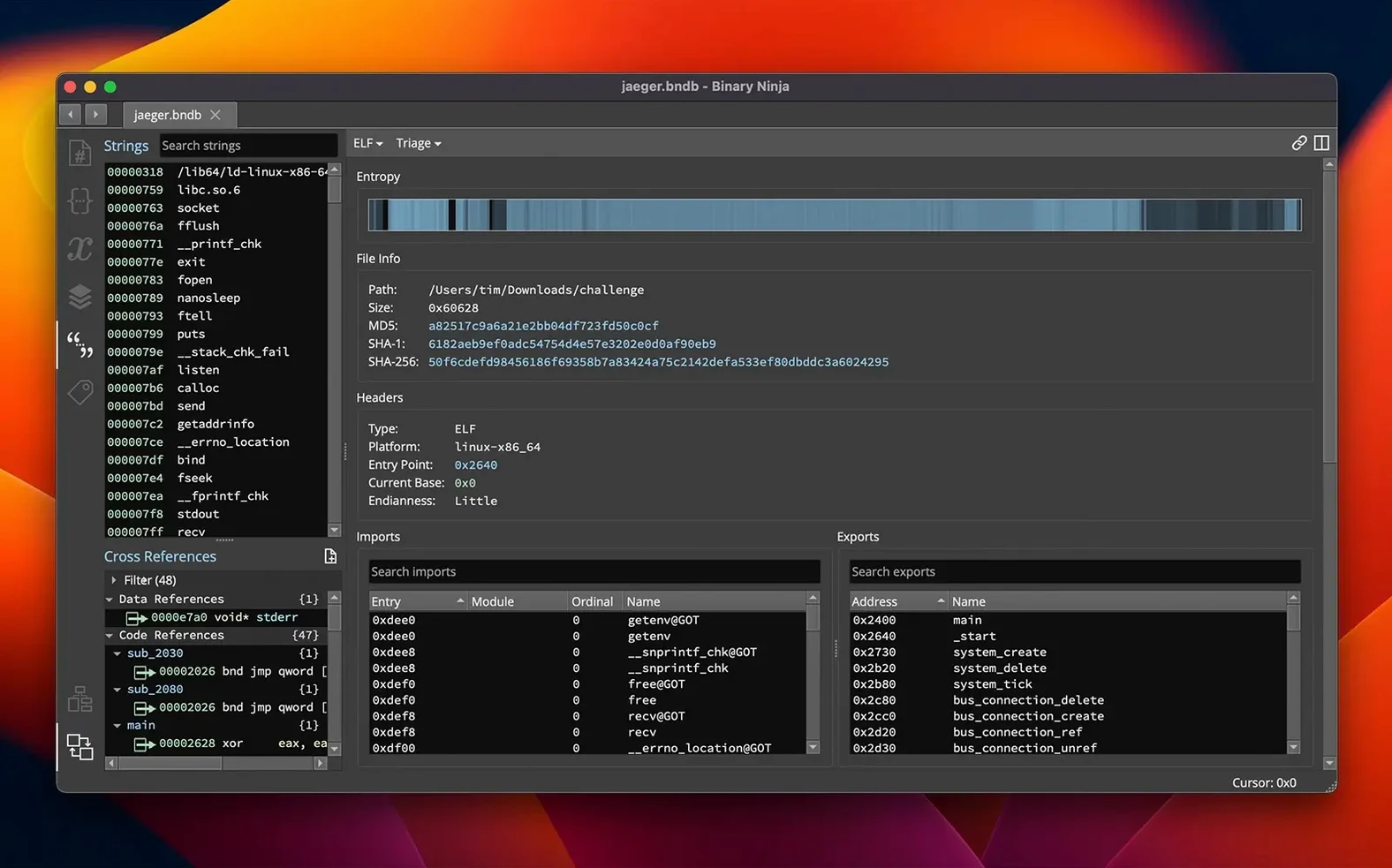
- Bookmark the entropy graph. Switch to it the moment you open an unfamiliar file. High-entropy regions flag packed or encrypted sections before you waste time stepping through garbage.
- Set up a snippets folder. Save your most-used Python one-liners — patching a branch, dumping a string table, searching for a byte pattern — so you are not rewriting them from scratch.
- Install extensions on day one. The redesigned Extension Manager in version 6.0 lets you browse and activate community plugins without leaving the workspace. A good architecture module or signature library saves hours of manual labelling.
If you hit a binary that resists analysis, run a quick entropy scan and cross-reference the entry point. The combination usually reveals whether the file is packed, obfuscated, or just compiled with an unfamiliar toolchain.
Triage Suspicious Mach-O Binaries Before the Sandbox Finishes
Malware analysts benefit from the speed of the linear sweep and recursive descent disassemblers. You can triage a suspicious Mach-O binary, spot the dropper routine, and annotate it before your sandbox finishes spinning up. The decompiler's C output reads cleanly enough that you can share annotated listings with colleagues who never touch assembly.
Vulnerability researchers working on ARM or x86-64 targets will lean on the type system and structure editor. Define a struct once, apply it everywhere it appears, and the decompiler propagates member offsets through every reference. That alone turns a week of manual offset arithmetic into an afternoon of reading reconstructed logic.
Embedded developers reversing firmware for 6502 or Z80 controllers get a disassembler that handles non-standard memory maps without complaint. Load your ROM, define memory regions, and start tracing the reset vector. The lightweight UI stays responsive even on large dumps.
Spot Suspicious Payloads via the Entropy Graph
Let's say you pull a suspicious ELF binary from a sandbox run. You drop it into Binary Ninja. The entropy graph lights up in the .text section — normal — but also flags a spike near the end of the data segment.
You jump to that offset. The hex view shows what looks like a second ELF header buried in the data. You mark the region, tell Binary Ninja to treat it as a separate binary, and open it in a new tab. The disassembler resolves a tight loop that calls connect(), recv(), and execve() in sequence. You name the function reverse_shell_setup.
Switch to the decompiler. The C output shows the socket family, port, and command string as immediate values. You right-click the port constant, choose "Create Structure," and start building a connection_config struct. From here, you patch the binary — edit the assembly to replace execve with a harmless exit, then write the patched bytes back to disk using the hex editor built into the platform.
If a colleague needs the analysis in a headless pipeline later, you export the database and point a Python script at it. The same annotations, names, and types carry forward. For those searching for a Binary Ninja crack download or a Binary Ninja torrent, the real utility is in that database continuity — cracked copies let you explore the collaboration features that make the platform worth learning. Others hunting a kick ninja crack or wondering what 1041 in binary represents will find more value in running the genuine binary through a proper disassembler and seeing the structure themselves.
- New — MCP server and Binary Similarity feature.
- New — TMS320C6x architecture support.
- Improved — Plugin Manager redesigned as Extension Manager.
- macOS 10.15 or later
- Apple Silicon and Intel Macs
Comments 0
Sign in to leave a comment.Sign inCreate an account
No comments yet. If a step is still there after you install it, say so.
More in Mac Apps
All in Mac Apps Bitwig Studio
Combines linear recording with a modular sound design sandbox in a single workstation.
5 steps saved
 Updated
BetterZip
Lets you preview an archive’s contents without extracting it first.
19 steps saved
 BetterTouchTool
Maps unused trackpad gestures and key sequences to the commands you repeat daily.
6 steps saved
 Blocs
Builds responsive websites visually while keeping clean, class-based code under the hood.
13 steps saved
 Updated
Bloom
Sorts a messy folder of mixed assets into subfolders by file type or creation date.
12 steps saved
 BetterDisplay Pro
Overrides the factory EDID so your screen matches the brightness and resolution you need.
14 steps saved
 Beauty Box Photo
Smooths skin texture automatically while keeping eyes and hair sharp.
5 steps saved
 BBEdit
Opens massive plain-text files and lets you edit them without a lag spike.