
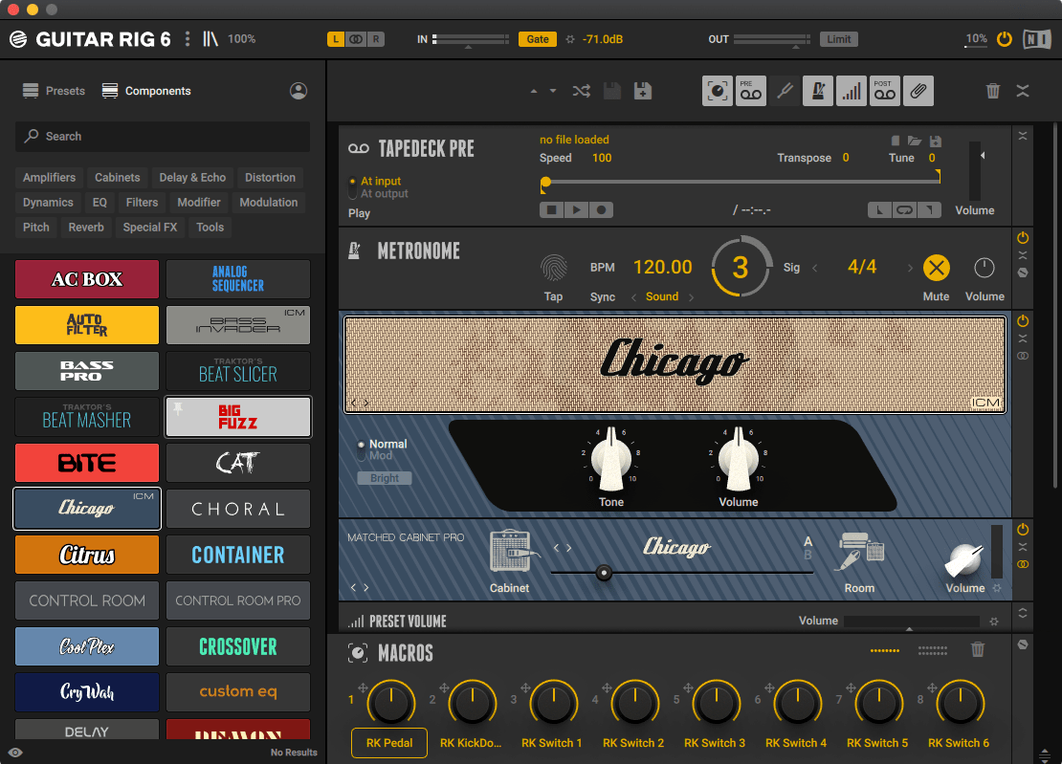
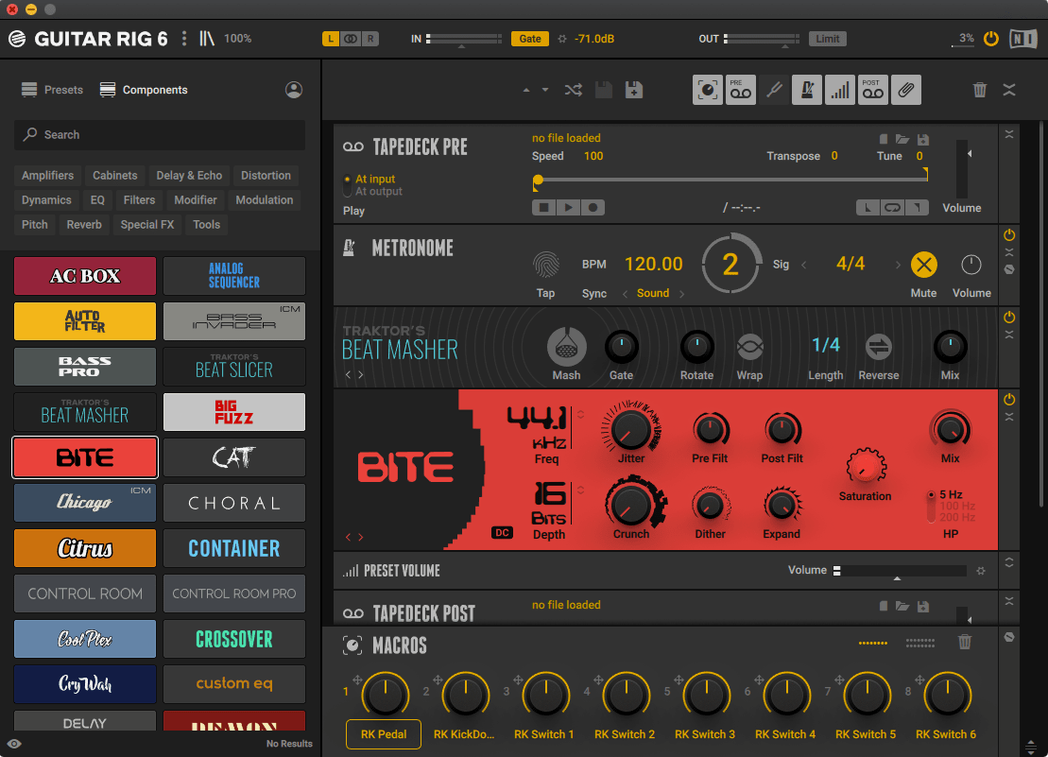
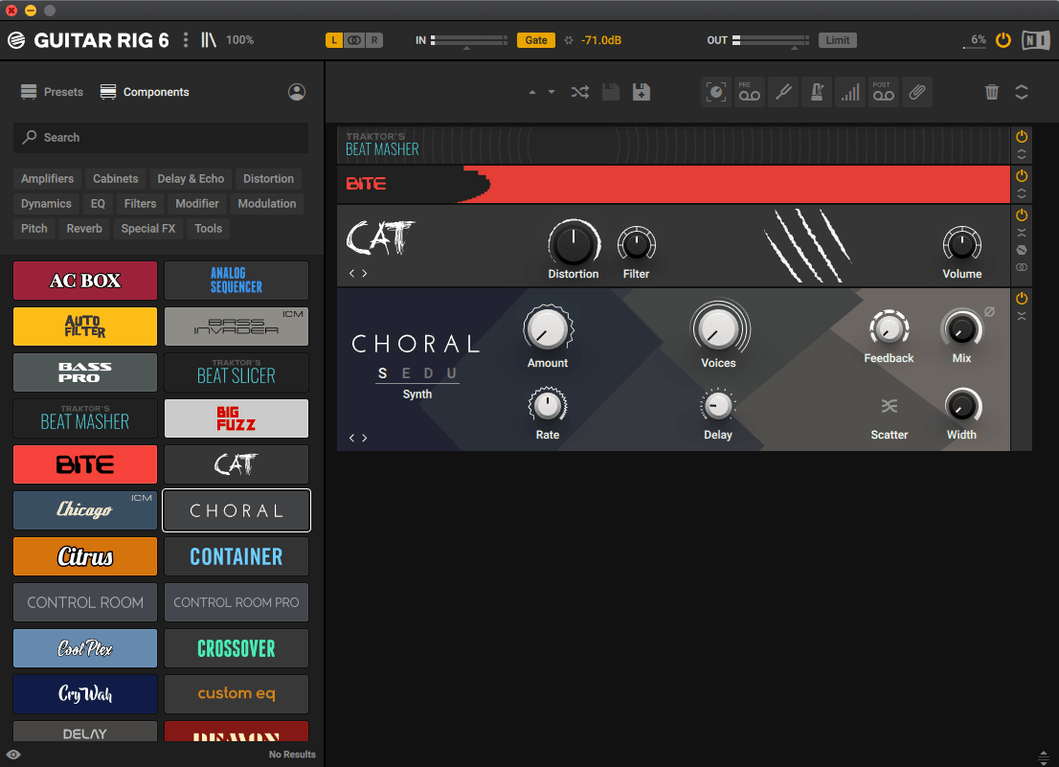
You plug in, load a preset, and the clean signal from your guitar turns into a stack of vintage amps, a stereo delay, and a spring reverb — all before it hits your DAW. Guitar Rig 7.0.2 processes guitar and bass through complex, configurable chains right on your Mac.
Drag-and-drop effect chain building
- Building layered effects chains with drag-and-drop simplicity
- Quick tone matching with a tag-based preset browser
- Silent practice or DI recording with amp and cabinet simulation
- Tuning up with the built-in tuner before a take
- Managing volume presets for consistent output levels
Methodical tagging unlocks the preset library
- Requires macOS 11 or later; Native Instruments lists macOS 13, 14, and 15 as tested
- Runs natively on both Intel (x86 64-bit) and Apple Silicon (ARM) Macs
- A large preset library rewards a methodical tagging habit
First days with Guitar Rig
Start with three presets, not thirty. Pick one clean amp, one crunchy rhythm tone, and one lead with delay. Save copies under your own names before you touch a single knob. The tag system stays useful only if you tag early — add practice, recording, or the guitar model you used.
Set the standalone app’s input to your interface and confirm the buffer size before judging latency. A 128-sample buffer feels immediate for practice; drop to 64 if your Mac handles it during recording.
Light idle, heavier under convolution loads
On an Apple Silicon Mac, preset switching feels quick and the interface redraws without stutter. Intel machines run it fine too, though heavier chains with multiple convolution-based cabinets ask more of the CPU. The app idles lightly when no audio passes through it.
Memory use stays modest for what it loads. A single instance in your DAW rarely causes trouble, but eight instances each running a full amp-plus-effects chain will add up. Freeze or bounce tracks when you settle on a tone.
Alongside your other tools
Guitar Rig sits naturally inside Logic, Ableton Live, or any host that reads AU or VST3. Use it as an insert on a recorded DI track and you keep the option to re-amp later. The standalone mode pairs well with a simple audio interface for practice without opening a DAW.
macOS features slot in without friction. Route the output through a multi-output device to send the processed signal to headphones and a reference speaker at once. The tuner works with any connected input, so it doubles as a quick check before acoustic takes.
Some users look for a guitar rig torrent mac to test version 7 before committing time to preset organisation. That is a viable way to explore the rack, and the catalog download here is ready for daily use.
- macOS 11 or later
- Intel (x86 64-bit) or Apple Silicon (ARM) Mac
Questions I get before install
Does Guitar Rig 7 run on Apple Silicon Macs?
Yes, version 7.0.2 runs natively on ARM architecture and is listed as supported on macOS 13, 14, and 15 for Apple Silicon Macs.
Comments 0
Sign in to leave a comment.Sign inCreate an account
No comments yet. If a step is still there after you install it, say so.
More in Mac Apps
All in Mac Apps Guitar Pro
Writes and plays back tablature and sheet music for stringed instruments.
6 steps saved
 Haptyk
Generates typing sounds that respond to how firmly you press the keys.
17 steps saved
 GoLand
Surfaces goroutine leak data inline to start debugging immediately.
22 steps saved
 Glyphs
Creates and edits complete font families, from the first glyph to export.
23 steps saved
 Updated
Ghost Buster Pro
Cleans up orphaned support files left behind by deleted apps.
12 steps saved
 Gemini
Targets and removes exact duplicate files that waste drive space.
22 steps saved
 HitPaw Edimakor
Pairs a standard timeline with AI tools so you can cut video without a steep learning curve.
13 steps saved
 Updated
FxFactory Pro
Installs and manages video effect plugins for Final Cut Pro, Motion and Premiere.