
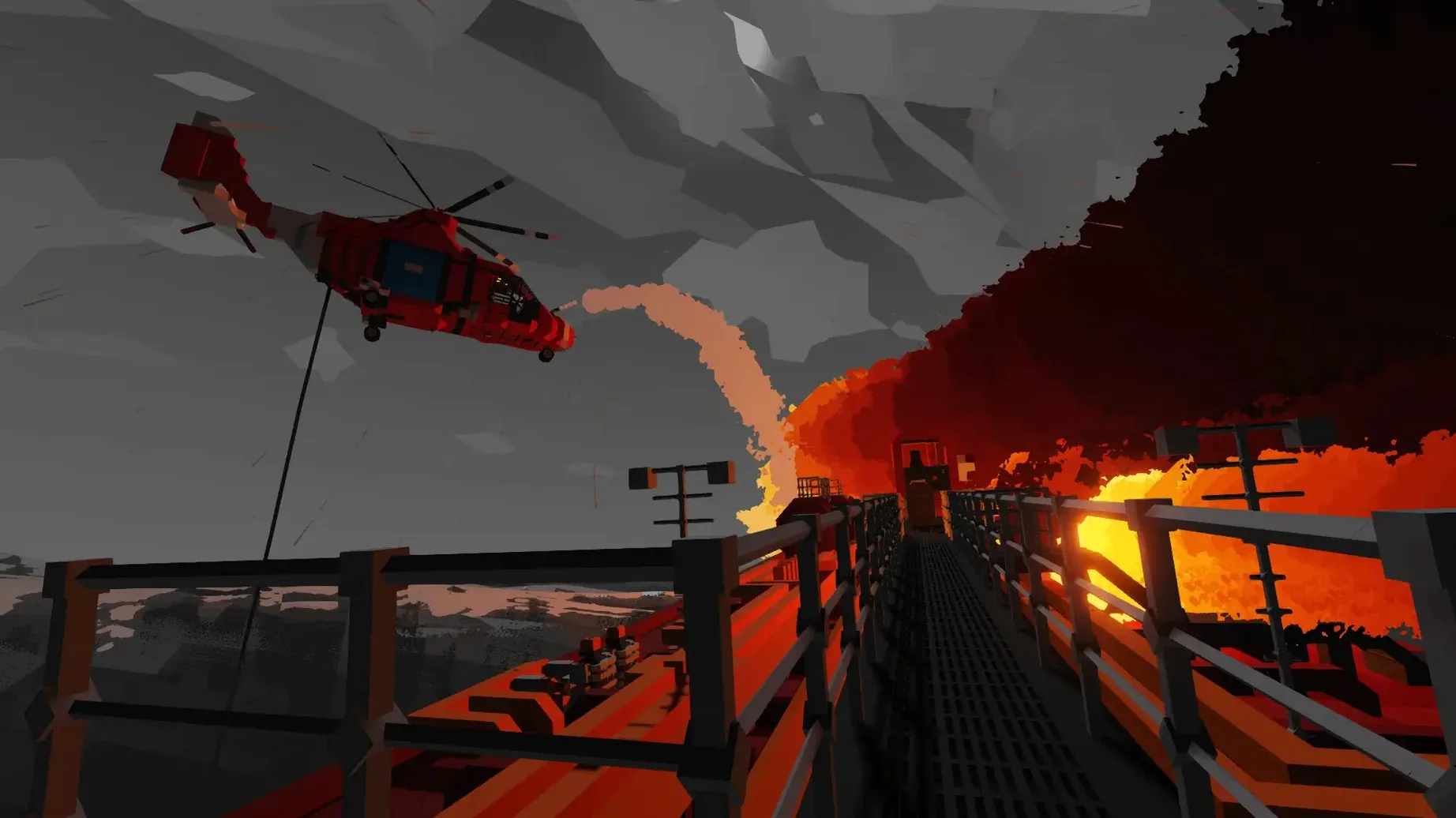
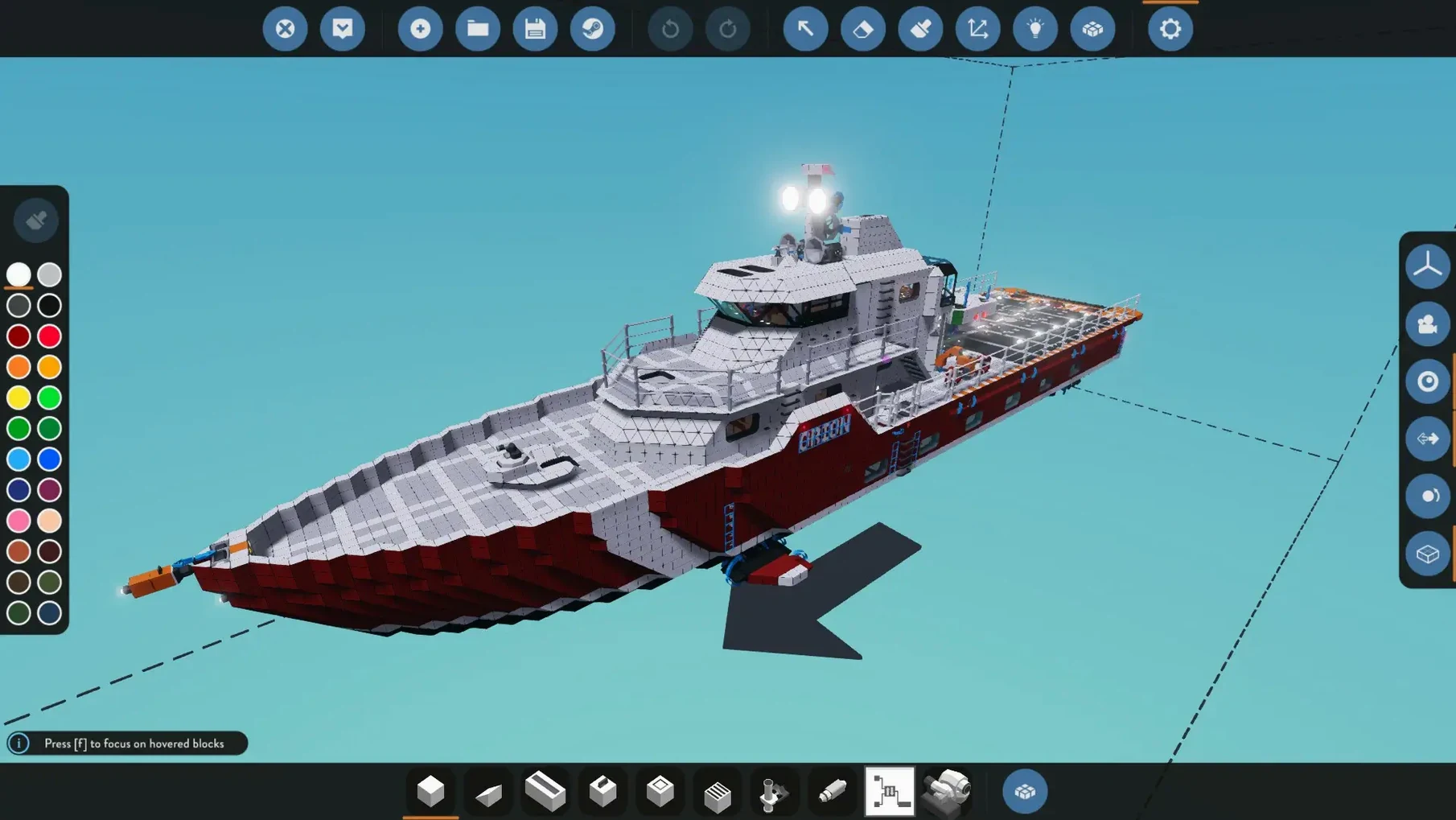
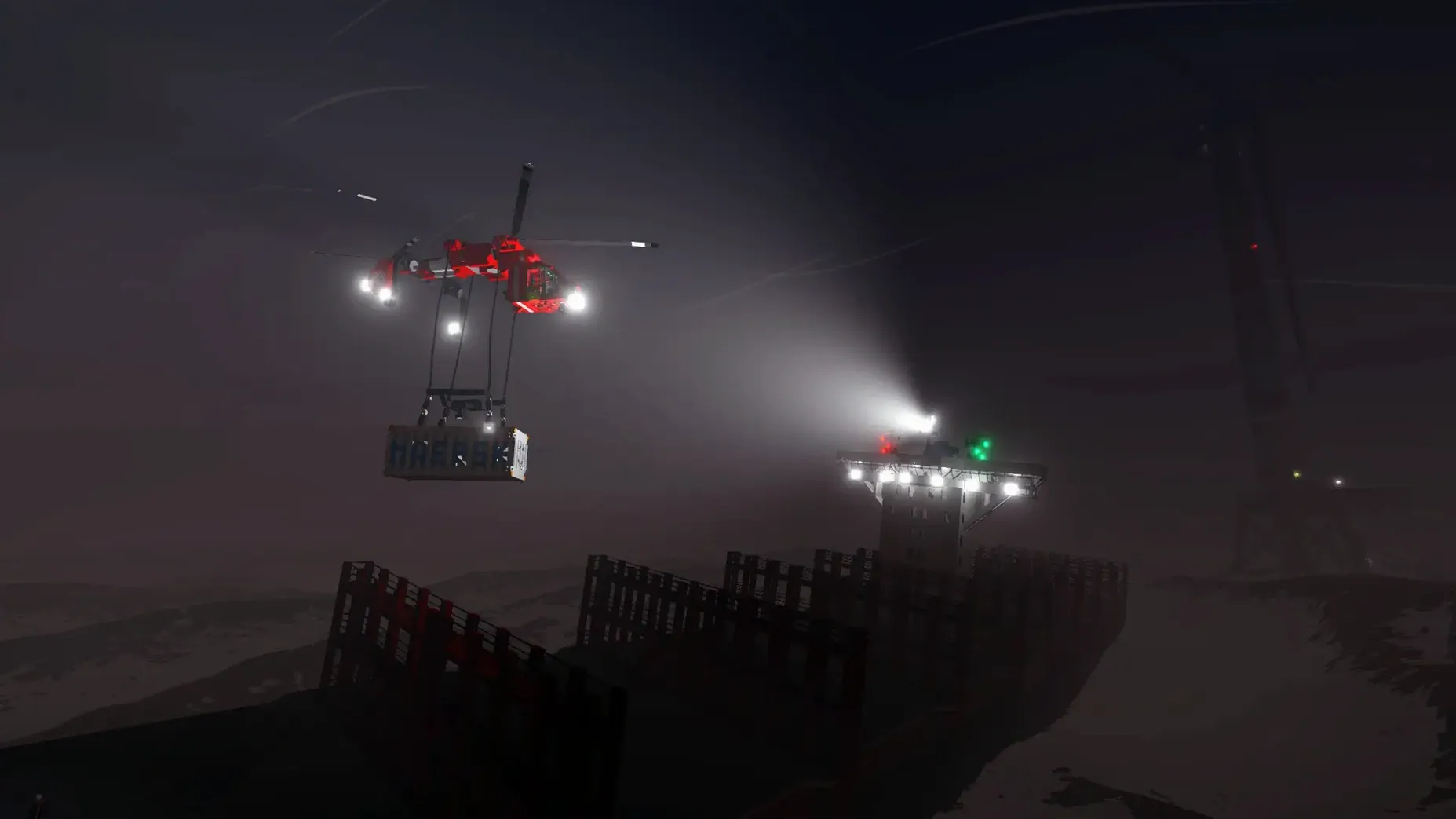
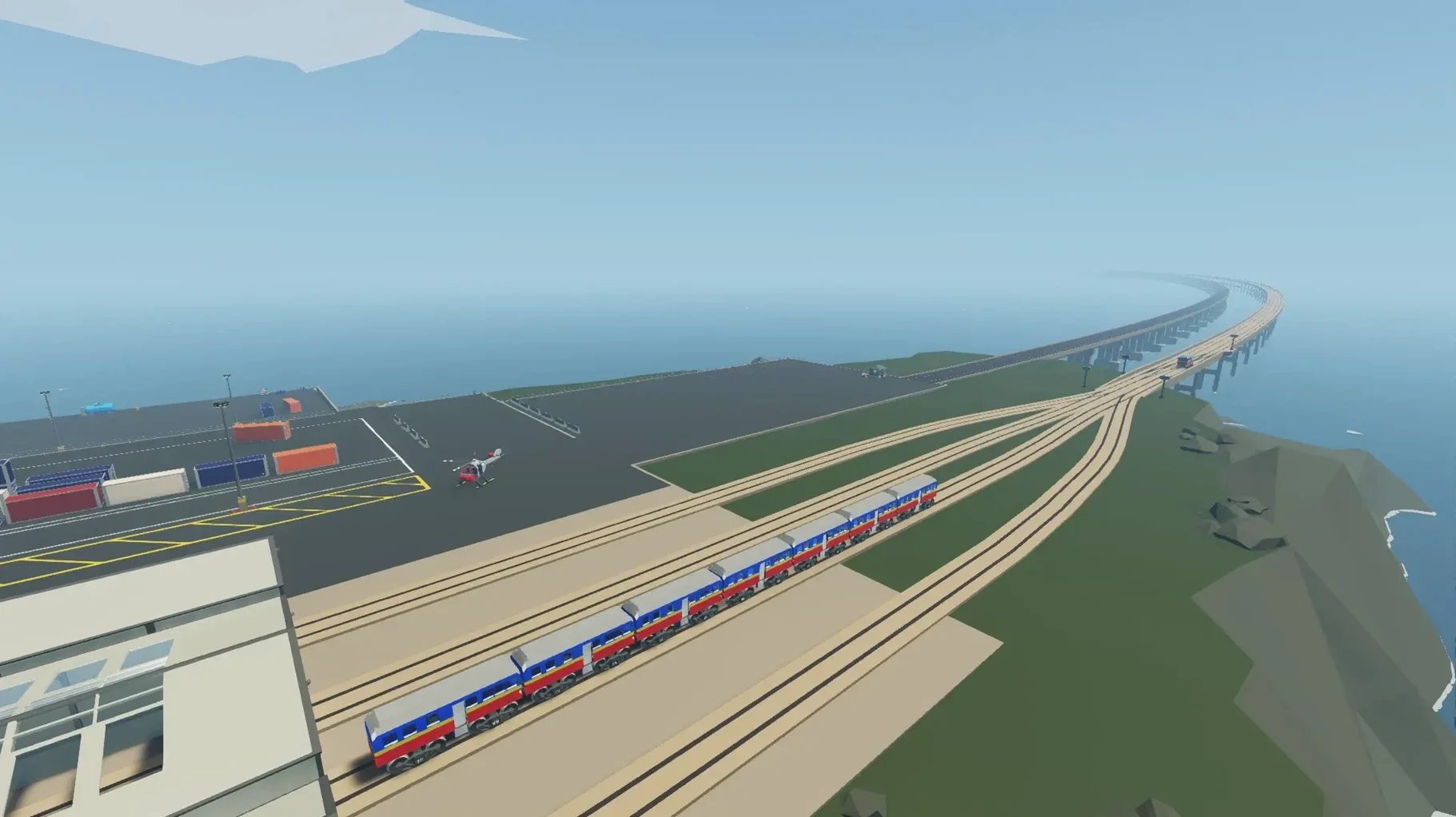
Most rescue games hand you a pre-built helicopter and a script. Stormworks drops you into an unforgiving ocean with a block editor and a problem to solve. You design the vessel, wire its controls, and live with every design decision once the weather turns.
The vehicle editor is the core. You snap together blocks to build boats, helicopters, planes, and submersibles, then route power, fluids, and logic signals through an in-game visual programming system. In survival difficulty, your creations take damage, engines burn fuel, and a miscalculated ballast tank means a one-way trip to the seabed.
Career mode turns those vehicles into tools. Missions spawn dynamically — stranded sailors, offshore fires, sinking cargo ships — and you respond with whatever you have built. Hazards compound fast: sharks circle survivors in the water, and hypothermia sets in from prolonged exposure, so response time matters. Creative mode strips out the pressure and gives you unlimited resources to prototype absurd contraptions or share them through the built-in Steam Workshop.
Three early walls that sink most new builds
New players often hit the same three walls during their first few hours. Knowing them upfront saves a rebuild.
Buoyancy goes wrong in the editor. The sealed volume display only updates when the compartment is fully enclosed. A single missing block gap lets water flood the space, and the readout stays blank. Check every corner with the slice tool before launching — especially around windows and custom hatches.
Logic connections behave unexpectedly. If a throttle lever sends a signal but the engine ignores it, the problem is almost always a broken connection chain inside a microcontroller. Open the controller, trace the composite signal path, and confirm every node passes the expected value range in the tooltip. Off-by-one channels are the usual culprit.
Career mode spawns fail to trigger. Missions depend on a powered, crewed vehicle within range of a compatible workbench. If you are standing on an empty dock with no active vessel, the dispatcher stays silent. Build a small runabout first, place a seat, add a basic radio receiver, and wait thirty seconds. The call should appear.
Native Apple Silicon binary included
Does this run on an M1 or M2 Mac without Rosetta? Yes. The build includes native ARM support alongside x86-64 — one binary handles both architectures, so Apple Silicon Macs open it directly.
Can I play without a Steam connection? The game launches and runs single-player modes without an internet connection. Workshop uploads and downloads need a live Steam client, but the editor, career, and creative modes function offline.
What controller or input gear works best? Keyboard and mouse cover the editor, flight, and logic wiring without any gaps. HOTAS setups and gamepads work for piloting but do not replace the mouse for block placement or Lua scripting, so keep both within reach.
How punishing is survival difficulty for someone who just wants to build? You can toggle survival settings per save — disable damage, fuel burn, or hazards individually. Creative mode removes all of them outright. There is no enforced progression gate; the difficulty sliders let you practice complex rescue sequences before sharks and hypothermia complicate the run.
It runs natively on both Apple Silicon and Intel Macs. One executable, English interface, no platform compromises.
Version 1.15.26 Native is now available. The developer has not published a public change log for this release.
- Apple Silicon
- Intel 64-bit
Comments 0
Sign in to leave a comment.Sign inCreate an account
No comments yet. If a step is still there after you install it, say so.
More in Games
All in Games Updated
Stellaris
Guides a spacefaring civilization from first interstellar steps to galactic dominance on a sprawling map.
18 steps saved
 STORROR Parkour Pro
Chains hundreds of parkour animations into an uninterrupted rooftop run.
14 steps saved
 Static Dread: The Lighthouse
Keeps a lighthouse lit while the surrounding village descends into ritual horror.
5 steps saved
 Stardew Valley
Restores a neglected farm and rebuilds a whole town, season by season.
5 steps saved
 Sons Of The Forest
Lets a small team survive together on a hostile island after a rescue mission unravels.
21 steps saved
 Songs of Conquest
Asks you to make hard tactical choices with a faction and a Wielder each turn.
23 steps saved
 Software Inc
Simulates building a product company from an empty floor and a bare bank account.
15 steps saved
 Sniper Elite 4
Delivers deliberate marksmanship where distance, wind, and heartbeat shape each shot.