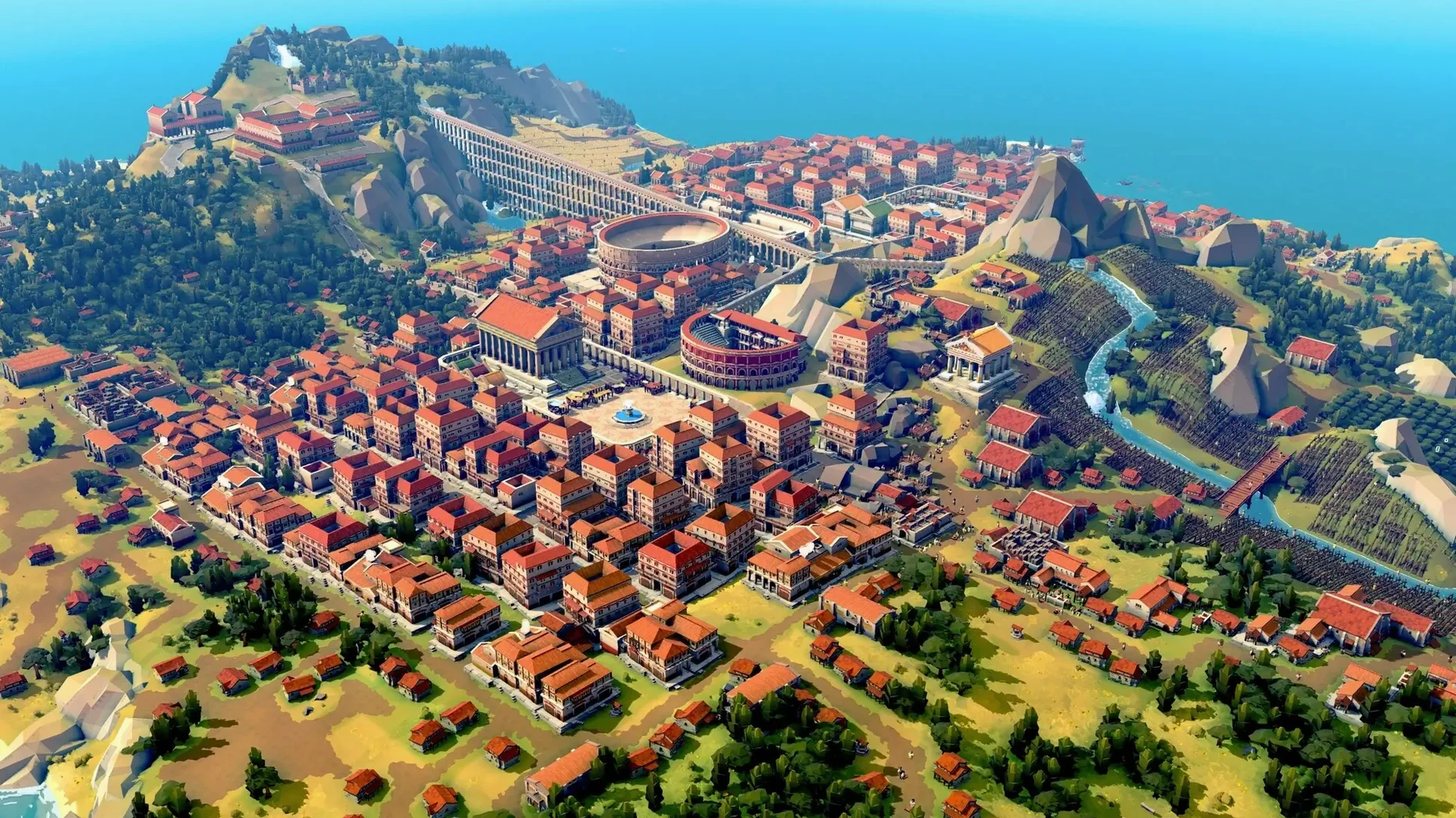
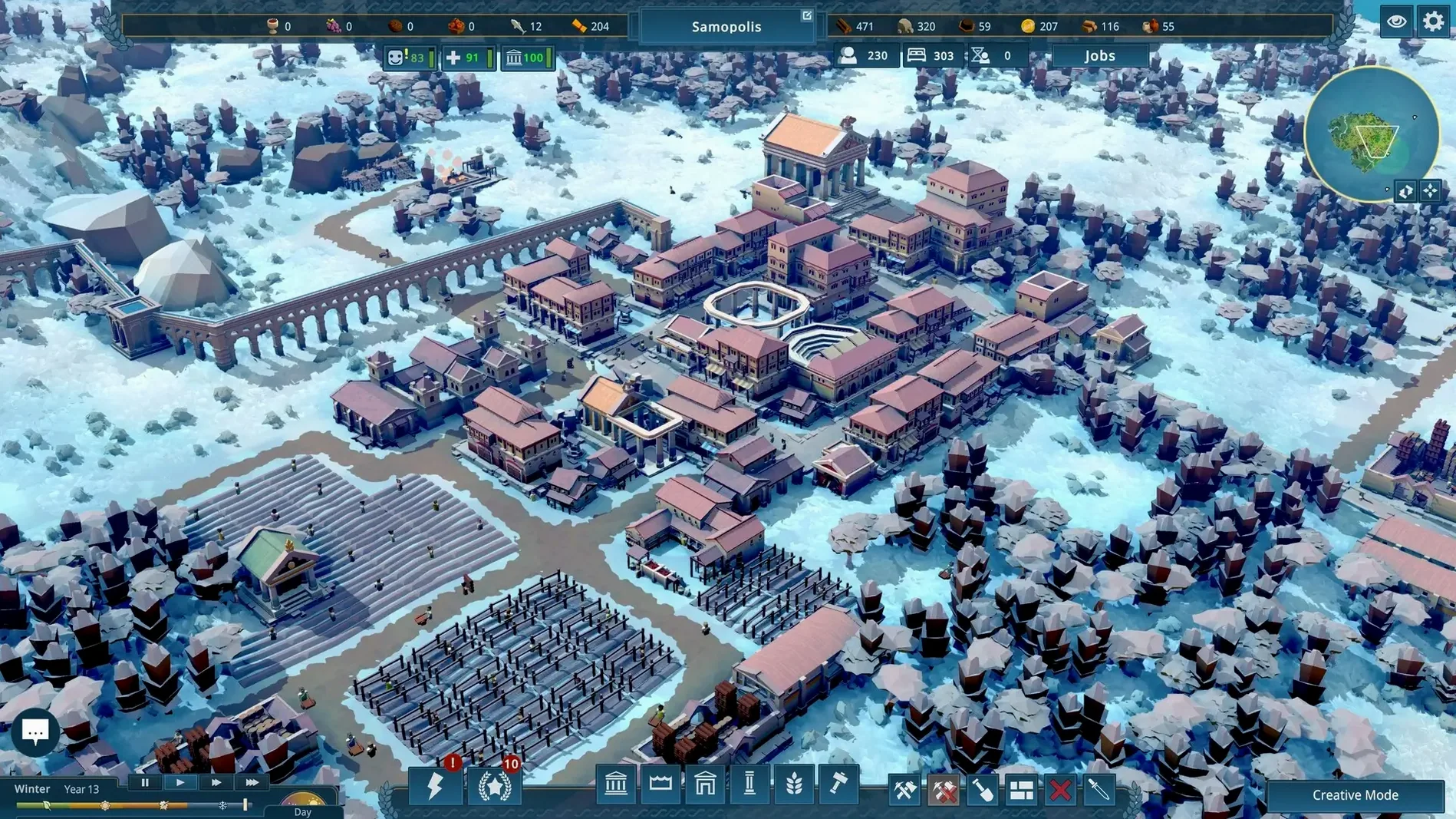
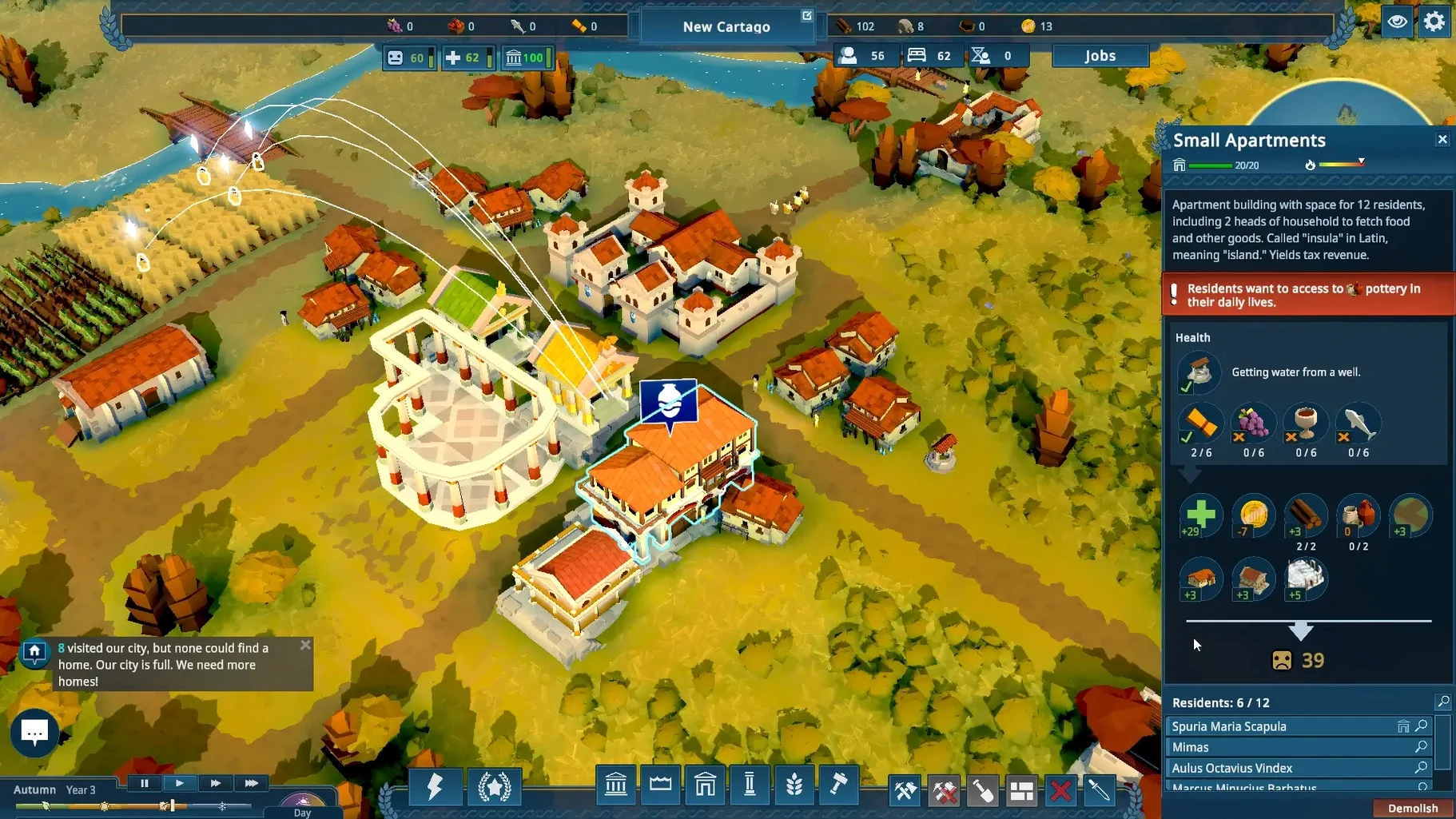
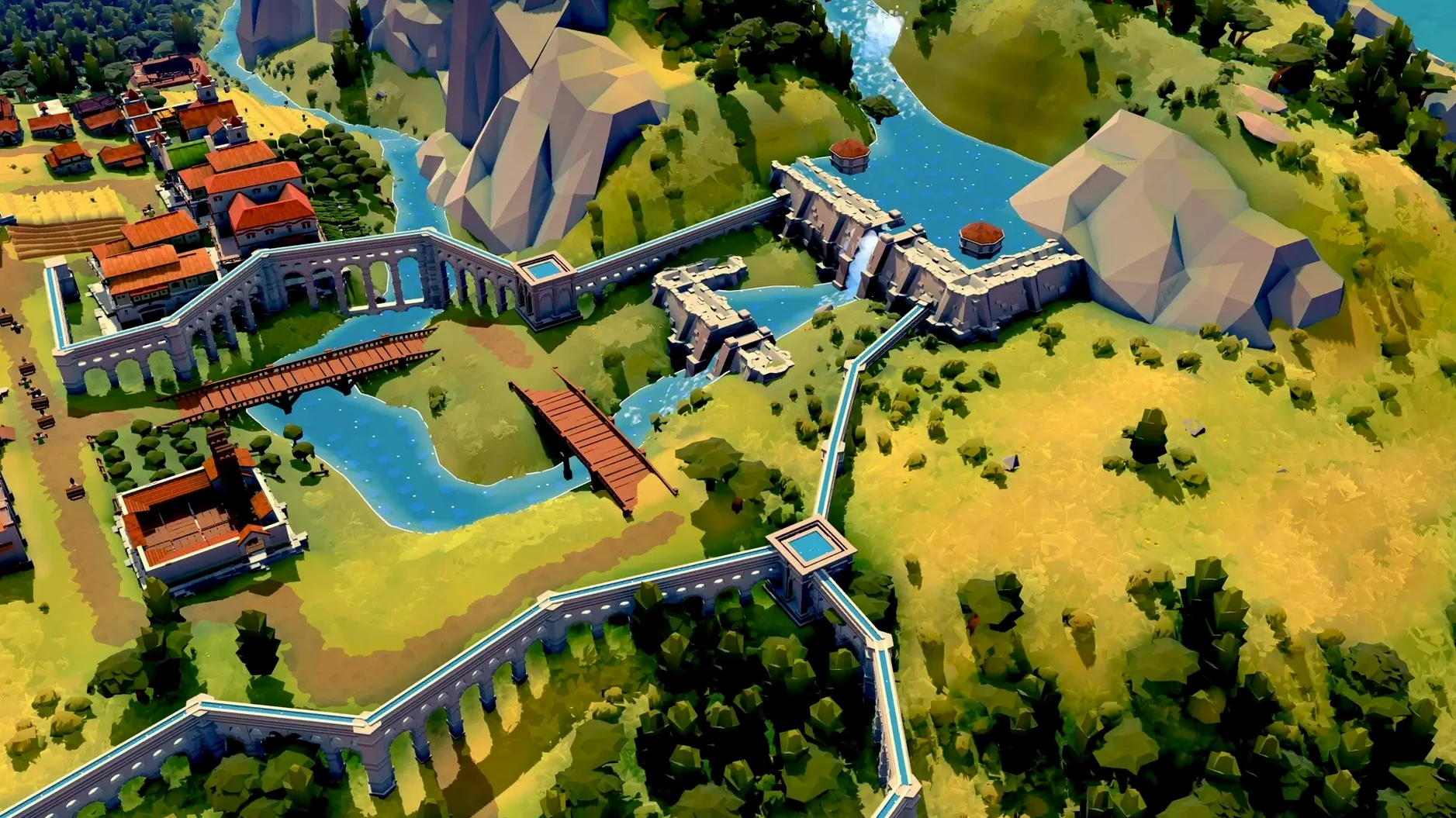
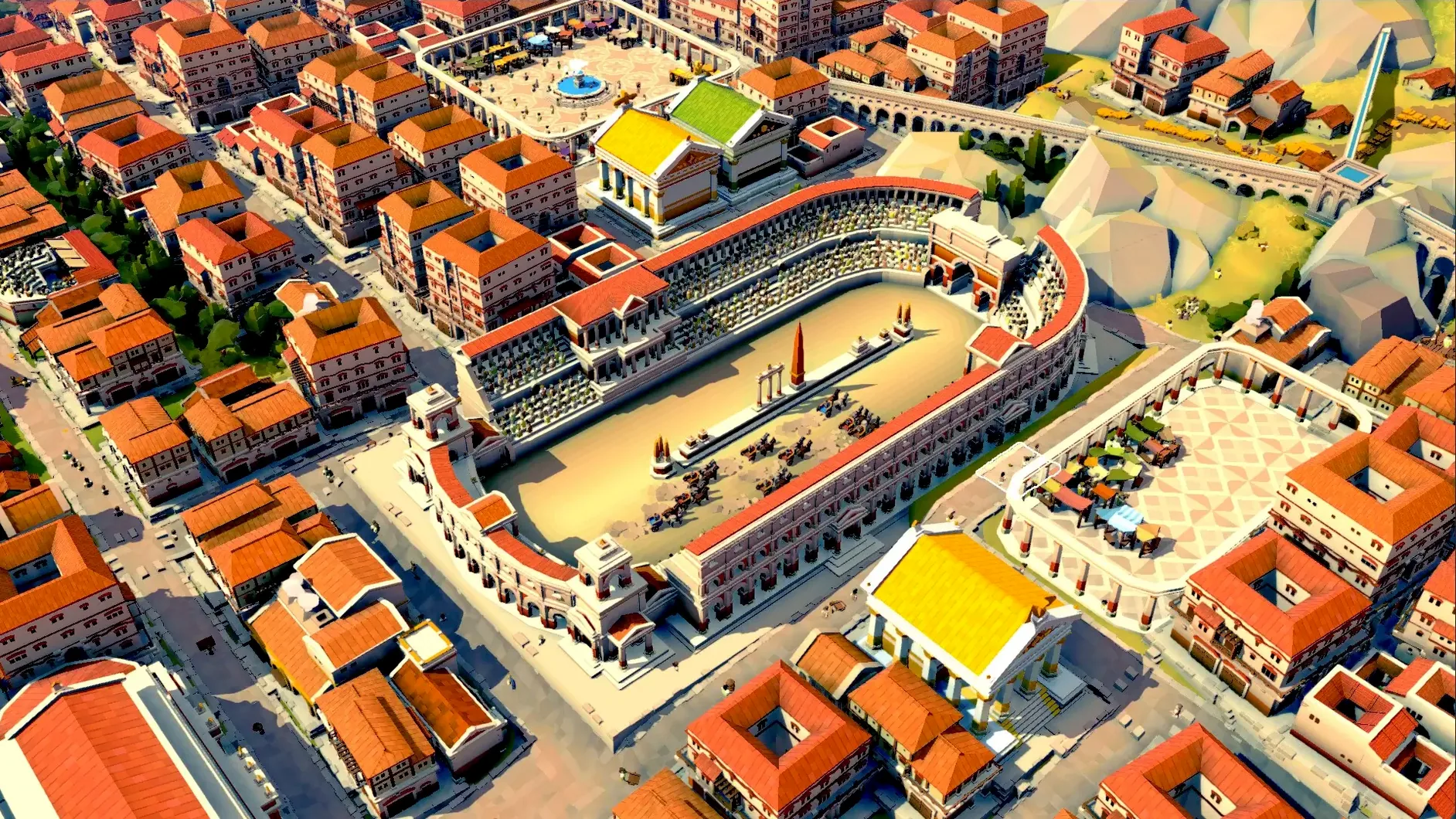
You draft the first water law, then notice the granary is half empty and the Temple of Jupiter still needs marble. A cart of wine is stuck at the gate because you forgot to assign a labourer. Nova Roma runs on many plates at once.
- Balance bread, wine, and public order while citizens react to shortages in real time
- Enact laws that shape taxation, labour, and religious observance
- Build aqueducts, dams, and temples to keep both the city and the gods satisfied
- Train gladiators, craftsmen, and actors to generate culture and revenue
- Research technologies that unlock new civic structures and production chains
This is a logistics sandbox for players who enjoy watching a system strain under its own weight. If you prefer spectacle over spreadsheets, or want fast combat rather than slow policy, it will feel like work. For the detail-oriented planner, it lands squarely in the zone where one more tweak keeps you up past midnight.
3× Speed Holds Smooth When Aqueducts Span Half the Map
Version 0.7.2703 runs with a quiet confidence on both Apple Silicon and Intel Macs. Frame pacing stays smooth at 3× speed even when the aqueduct grid stretches across half the map and two hundred citizens are pathfinding through a festival crowd. No stutter, no memory creep after hours-long sessions.
RAM use hovers around 1.8 GB on a typical 800-citizen settlement. The fan rarely spins up unless you leave the weather simulation on storm mode while the dam system recalculates flow across every tile. Autosaves complete in under a second — barely noticeable.
Stability is where the build earns trust. Across dozens of hours, crashes are rare. When they do occur, the culprit is usually a specific law combination that triggers a logic conflict in the taxation module, and the autosave is recent enough that you lose maybe ninety seconds. For a game still in development, that reliability shapes the whole experience. You stop worrying about the engine and focus on why the bathhouse queue is blocking the butcher's delivery cart.
Double-Right-Click a Citizen to Trace Broken Supply Chains
Several shortcuts sit just outside the tutorial's reach. Learning them early saves friction.
- Double-right-click a citizen to follow their daily loop. It reveals exactly where supply chains break — a baker walking past idle mills because the warehouse priority is set wrong.
- Hold Option while placing an aqueduct segment to lock it to the existing slope. This prevents the accidental one-tile dip that ruins water pressure across a district.
- The F3 overlay colours every structure by labour availability. Green means fully staffed; amber means partially filled; red means the building is idle. Most players discover this by accident around hour ten.
- Law proposals queue in the Senate tab even while a previous debate runs. You can draft three edicts during a slow harvest cycle and ratify them back-to-back when the senators convene.
- Right-click a god's temple to see the exact favour decay rate and the last three events that raised or lowered it. Useful when a sudden plague makes no sense until you realize Mars has been ignored for two seasons.
The irrigation overlay deserves its own mention. It does not just colour tiles blue — it shows flow direction, pooled water from recent rain, and evaporation estimates. If you enjoy the dam-building aspect of the game, this screen becomes your command centre.
Beside Other Roman City-Builders
Set Nova Roma next to three similar titles and the differences sharpen quickly.
Caesar IV shares the setting and the god-appeasement loop, but its economic model is simpler. Nova Roma pushes deeper into water physics and law-making. Where Caesar IV treats aqueducts as a binary supply check, Nova Roma tracks gradient, flow rate, and seasonal evaporation. The trade-off: Caesar IV feels more polished as a complete product, while Nova Roma 0.7.2703 still exposes its work-in-progress edges in the late-game tech tree.
Nebuchadnezzar competes on logistics complexity. Both games ask you to route goods through multiple processing steps, and both punish bottlenecks harshly. Nova Roma adds two layers Nebuchadnezzar omits: law enactment with delayed political consequences, and a weather system that alters crop yields and water levels independently of your planning. The interface in Nebuchadnezzar is more keyboard-driven; Nova Roma leans on mouse-and-overlay workflows that suit a Mac trackpad well.
Pharaoh: A New Era offers monument construction and Nile flood cycles. Nova Roma's dam and irrigation system fills a similar role — a seasonal, terrain-shaped challenge — but replaces the binary flood/drought rhythm with continuous hydrodynamic simulation. Monument building in Pharaoh is grander; Nova Roma's temples feel functional rather than spectacular.
Where Lion Shield's game carves its own space is in the tension between short-term survival and long-term legislation. You are not just placing buildings — you are governing a population that remembers every tax change and every neglected festival. Other city-builders let you ignore the people once the granary is full. Nova Roma does not.
The native build of Nova Roma lands at version 0.7.2988.
- macOS version not specified
- Apple Silicon and Intel 64-bit (native)
Questions I get before install
Does Nova Roma run on Apple Silicon Macs?
Yes, the macOS build has been tested on both Apple Silicon and Intel 64-bit architecture.
What languages does Nova Roma support?
The interface is available in 16 languages including English, German, Spanish, French, Japanese, and Korean. The game has music but no spoken dialogue.
What systems can I manage in Nova Roma?
You manage taxation, food supply chains for bread and wine, religious favour through temple construction, and civic professions such as gladiators, craftsmen, and actors.
Comments 0
Sign in to leave a comment.Sign inCreate an account
No comments yet. If a step is still there after you install it, say so.
More in Games
All in Games Updated
No Man’s Sky
Explores an endless galaxy, landing on planets without a loading screen.
16 steps saved
 Updated
Old World
Limits each turn by a pool of orders so every move carries strategic weight.
4 steps saved
 No, I'm Not a Human
Forces a grim choice at your door by studying faces and stories.
10 steps saved
 Oxygen Not Included
Makes you manage gas pressure and liquid runoff so your colony does not suffocate itself.
12 steps saved
 Palworld
Automates resource gathering and crafting by assigning creatures to your base.
15 steps saved
 Updated
NBA 2K26 Arcade Edition
Delivers console-scale basketball with MyPLAYER and franchise modes.
23 steps saved
 Updated
Paralives
Lets you build homes without a grid and steer characters through careers and relationships.
9 steps saved
 PIGFACE
Takes on brutal contract kills in a fast, bloody first-person shooter.